How to Choose the Best IP Ceiling Speaker for Modern Audio Communication Systems
June 18 , 2026

When audio communication plays a critical role in daily operations, selecting the right ceiling speaker becomes more than a matter of sound quality. From schools and hospitals to offices, transportation hubs, and commercial buildings, organizations increasingly rely on network-based audio systems to deliver announcements, emergency notifications, paging, and background music efficiently.
As a leading provider of IP audio solutions, TONMIND offers a range of professional IP ceiling speakers designed for modern network environments. This guide explores the key factors to consider when choosing the best IP ceiling speaker and explains why network-based audio technology is becoming the preferred choice for intelligent buildings.
An IP Speaker is a network-connected audio device that receives and processes audio over an Ethernet network instead of relying on traditional analog cabling. Unlike conventional speakers that require centralized amplifiers and extensive wiring, IP ceiling speakers integrate decoding, amplification, and network communication into a single device.
This architecture simplifies deployment while providing greater flexibility, scalability, and remote management capabilities.
Traditional analog public address systems often face challenges such as complicated wiring, limited scalability, and centralized points of failure. Modern IP audio solutions address these limitations by utilizing existing network infrastructure.
Key advantages include:
● Simplified installation through standard Ethernet networks
● Centralized management of multiple locations
● Flexible zoning and scheduling
● Real-time monitoring and diagnostics
● Easy integration with other building systems
● Support for emergency broadcasting and mass notification
These benefits make IP speakers an essential component of today's intelligent PA System deployments.
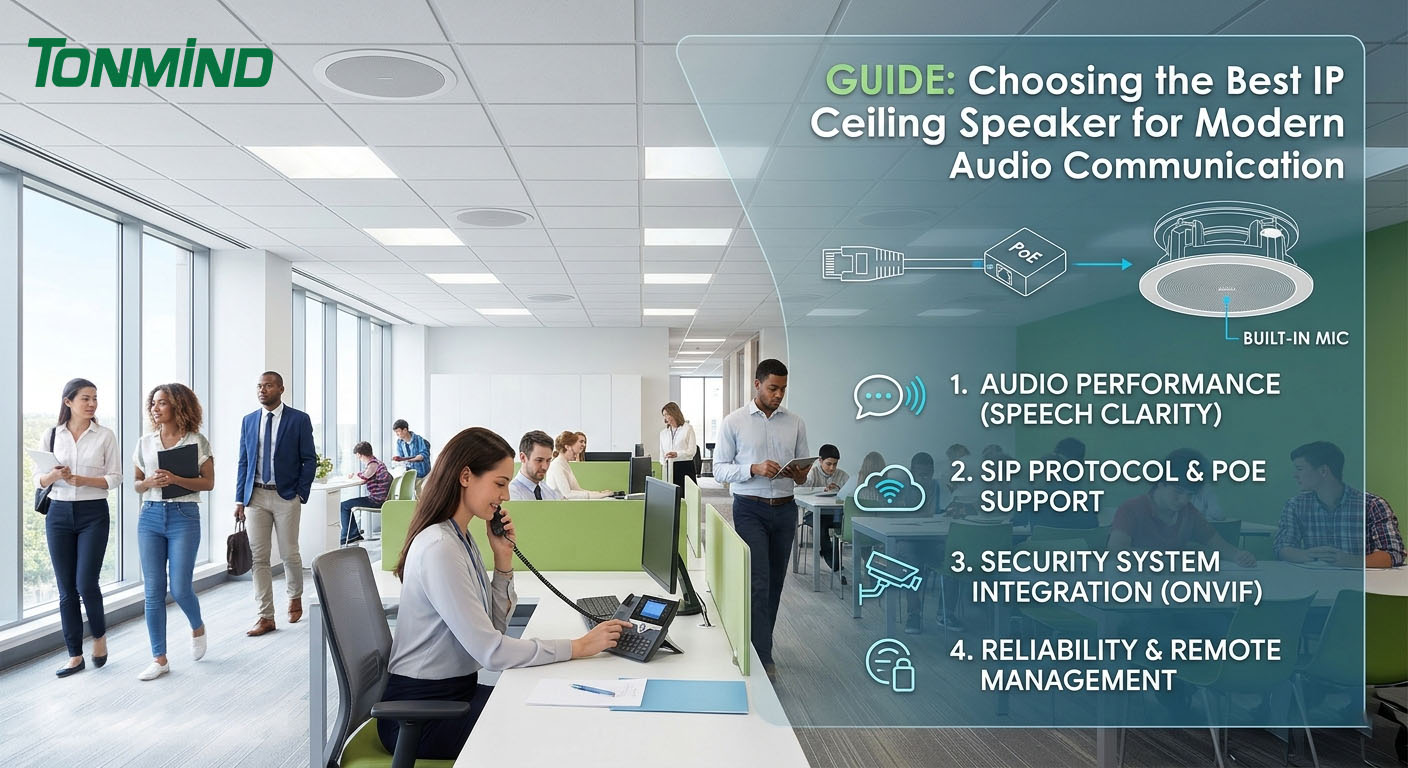
Sound clarity is the foundation of any successful paging or announcement system. A quality ceiling speaker should provide:
● Clear speech intelligibility
● Balanced frequency response
● Adequate sound pressure levels
● Consistent coverage across the installation area
For environments such as schools, healthcare facilities, and offices, speech clarity is often more important than high-volume output.
Protocol compatibility determines how easily a speaker can integrate into existing systems.
Look for support for:
● SIP protocol for VoIP-based paging and intercom communication
● Multicast audio streaming
● Standard IP networking protocols
● Remote configuration and monitoring
SIP compatibility enables direct integration with IP PBX systems, VoIP phones, and communication platforms, making enterprise deployments significantly more efficient.
As buildings become increasingly connected, audio devices are often expected to interact with surveillance and access control systems.
Many modern deployments require compatibility with ONVIF, allowing audio devices to work alongside IP cameras and video management systems. This integration supports intelligent security workflows, including automated voice alerts triggered by video analytics or security events.
Power flexibility can significantly reduce installation costs.
Common options include:
● PoE (Power over Ethernet)
● DC power supply
● Hybrid power configurations
PoE is particularly attractive because it delivers both power and data through a single network cable, simplifying installation and reducing infrastructure requirements.
For large-scale installations, centralized device management is essential.
Features worth considering include:
● Web-based configuration
● Remote firmware upgrades
● Health monitoring
● Event logging
● Network diagnostics
These capabilities reduce maintenance costs and improve long-term system reliability.
TONMIND specializes in professional IP audio and communication products for commercial and industrial applications. With an experienced in-house R&D team, the company continuously develops innovative solutions that combine advanced networking technology with reliable audio performance.
Among its product lineup, the 15W IP Ceiling Speaker with Microphone is designed for environments requiring both high-quality audio broadcasting and two-way communication.
Key features include:
● Full SIP compatibility
● Built-in microphone for intercom functionality
● PoE support for simplified installation
● High speech intelligibility
● Remote web-based management
● Flexible integration with VoIP and network communication systems
These capabilities make it suitable for educational campuses, healthcare facilities, office buildings, retail environments, and smart city projects.
Schools and universities use IP ceiling speakers for:
● Class change notifications
● Emergency announcements
● Campus-wide paging
● Scheduled broadcasts
Hospitals benefit from:
● Department-specific paging
● Emergency communication
● Background information broadcasting
● Staff coordination
Office complexes utilize network speakers for:
● General announcements
● Visitor notifications
● Emergency evacuation messages
● Building-wide communication
Airports, railway stations, and transit facilities require reliable audio systems capable of delivering clear information across large areas while integrating with security platforms.
Organizations investing in new audio systems should think beyond current requirements. Network-based audio solutions offer the flexibility needed to accommodate future expansion, additional locations, and integration with emerging smart-building technologies.
Choosing an IP ceiling speaker that supports standards such as SIP and ONVIF helps ensure compatibility with future communication, security, and automation systems.
Selecting the best IP ceiling speaker involves more than comparing power ratings and specifications. Audio quality, network compatibility, scalability, integration capabilities, and long-term reliability all play critical roles in system performance.
For organizations building modern PA System infrastructures, a professional IP Speaker solution with comprehensive SIP communication capabilities and ONVIF integration support provides a solid foundation for efficient, scalable, and future-ready audio communication.
With continuous innovation, strong engineering expertise, and a commitment to network audio excellence, TONMIND delivers solutions designed to meet the evolving demands of today's connected environments.